
Septic service
Drain Field Repair Jacksonville
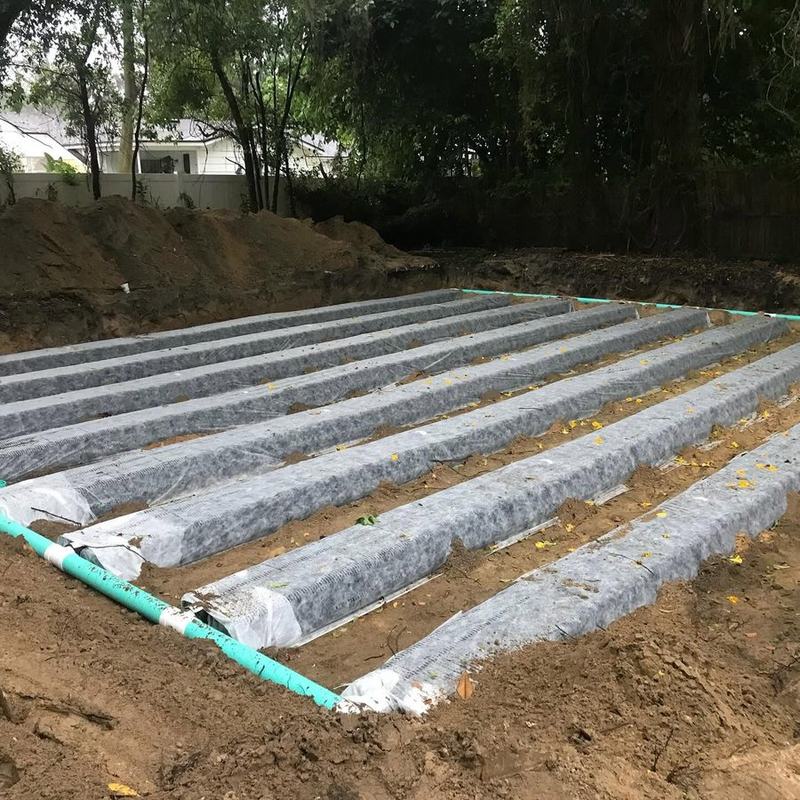
The most expensive part of a septic system, and the one most often killed by a pump-out that was put off. If the yard is wet and the tank refills fast, this is the conversation.
Crews with 20+ years in the tradeLicensed & insuredOne-year warranty
Septic backing up? Call us now.
Sewage in the yard or the house, a tank that won’t drain, or a well with no water. Call and you will get a person and a straight answer about when we can be there.
How do you know the drain field is the problem?
The tell is what happens after a pump-out. If the tank empties and then refills quickly while the drains are still slow, the water is not leaving the field. A tank that stays empty and drains normally was simply full.
Alongside that: standing water or soft ground over the field during a dry stretch, grass that is markedly greener and spongier over the lines, smell outside that gets worse after rain, and backups that come back within weeks of the last pump-out.
Why fields fail here
Solids carried out of an overdue tank clog the soil around the lines and the field stops accepting water. That is the common one, and it is preventable.
The rest have nothing to do with pumping. A wet-season water table high enough to reach the field saturates it from below, so the effluent has nowhere to go. Roots find the lines. Vehicles or a slab over the field compact the soil or crush the pipe. And a field simply reaches the end of its service life.
Repair or replace
Not every failing field needs replacing. A crushed line, a failed distribution box or a blocked outlet filter is a repair. Soil that has stopped accepting water is not something that gets unblocked, and that is a replacement.
Telling those apart takes an evaluation, not a phone call. We do that before quoting a replacement, because the two outcomes are not close in cost and you are entitled to know which one you are facing.
How the estimate works
A replacement is permitted work, and the permit depends on a soil evaluation and the wet-season water table on your lot. That is days, not hours, and it is why nobody can give you a firm replacement number on the first call.
What you get from us on that call is a ballpark range, the two things that will move it, and a written estimate for the evaluation and permit stage. Call us and we’ll get you on the schedule. The firm number for the replacement follows once the results come back.
Where we do this work
We handle drain field repair across Duval, Clay, Nassau, St. Johns, Putnam, Union and Baker counties. Each area page covers the local ground conditions and which office issues the permit there.
Jacksonville · St. Augustine · Orange Park · Middleburg · Green Cove Springs · Ponte Vedra Beach · Fernandina Beach · Yulee
See every area we serve, all septic services, or who issues your permit.
How our estimates work
Some jobs we can price on the phone. The big ones nobody can, and we would rather tell you why than invent a number.
- 01
A ballpark on the first call
A range for a property like yours, and a straight answer on what would move it. Not a commitment, and we will say so.
- 02
A written estimate for the part we can price
On permitted work that means the site evaluation, the soil testing and the permit. You get it in writing, so the job can start.
- 03
A crew out to the site
The evaluation happens on site. The results are what the county needs and what your final number depends on.
- 04
The firm number, once it is knowable
With the soil results and the permit in hand, the price for the actual work is real rather than a guess with a margin built in.
Drain field repair — questions we get asked
How do I know if my drain field is failing or my tank is just full?
Watch what happens after a pump-out. If the tank empties and then refills quickly while the drains are still slow, water is not leaving the drain field and the field is the problem. If the tank stays empty and everything drains normally, it was simply full.
What causes a drain field to fail in Northeast Florida?
Most commonly, solids carried out of a tank that was not pumped on schedule clog the soil around the lines. A wet-season water table that rises high enough will also saturate a field from below, leaving it nowhere to discharge. Roots in the lines, vehicles or slabs compacting the soil over the field, and simple age account for the rest.
Can a failing drain field be repaired instead of replaced?
Sometimes. A crushed line, a failed distribution box or a blocked outlet filter is a repair. Soil that has stopped accepting water cannot be unblocked, and that is a replacement. An evaluation tells you which one you have, and the two are not close in cost.
How much does drain field replacement cost?
It depends on the soil evaluation, the wet-season water table and what the permit requires, so it cannot be quoted honestly on a first call. We give a ballpark range up front, tell you what will move it, and send a written estimate for the evaluation and permit stage so the work can begin. The firm replacement number follows once results are back.
Related services
Septic
New system installation
New construction, a replacement for a system at the end of its life, or an upgrade a county requires. All three start in the same place: what the soil and the water table on your lot will accept.
Read more →Septic
Aerobic treatment units
On coastal and low-lying lots, and inside Florida’s nutrient-reduction areas, a conventional system is often not an option. This is what the alternative is and what owning one involves.
Read more →Septic
Septic tank pumping
The single job that prevents most of the expensive ones. A tank that is pumped on schedule protects the drain field, and the drain field is the part you do not want to replace.
Read more →Tell us what the system is doing.
Call and talk to someone who works on these every day, or send the details and we will come back to you.